In modern times, many people may find it difficult to tell if something is real or created by artificial intelligence, or AI. As we continue through 2026, AI videos, images, and articles become more common. AI has been getting more advanced and developed by companies such as OpenAI, Google, and xAI.
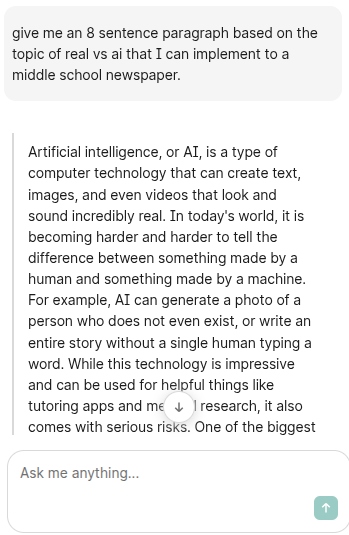
Artificial intelligence, or AI, is a type of computer technology that can create text, images, and even videos that look and sound incredibly real. In today’s world, it is becoming harder and harder to tell the difference between something made by a human and something made by a machine. For example, AI can generate a photo of a person who does not even exist, or write an entire story without a single human typing a word.
This paragraph was written fully by Grammarly AI. A simple prompt allowed it to write a paragraph. It shows how little work a person needs to do to “write” a good quality article. It becomes increasingly more difficult to tell the difference between an authentic, written article and an artificially generated one.
AI can be prompted to write like anyone in the world. It uses certain word choices, grammar, and figures of speech. Depending on what it is told, it can do even more than just write articles. AI is also capable of making photos, videos, and various other deep fakes. Deep fakes, or very realistic fake information, like this, make it hard to define a real product or a product generated by artificial intelligence.
AI is also very risky and can be dangerous. Artificial intelligence has access to information about you that you don’t even know about.
“We collect information about your use and activity across the Services, such as the types of content that you view or engage with, the features you use and the actions you take, when you submit feedback to a model response, the people with whom you interact, as well as your time zone, country, the dates and times of access, user agent and version, type of computer or mobile device, and your computer connection.” According to OpenAI, data is monitored on any device on which an individual has agreed to their privacy policy.
Many people will get a prompt on their screen when they open an AI program. This prompt asks the user to agree to the terms and conditions. The majority of users click “agree” without fully reading the terms and conditions. This results in data being taken and used for the AI to utilize.
This can be especially dangerous to children using the app. Hackers can use this data to find out location, and other personal information.