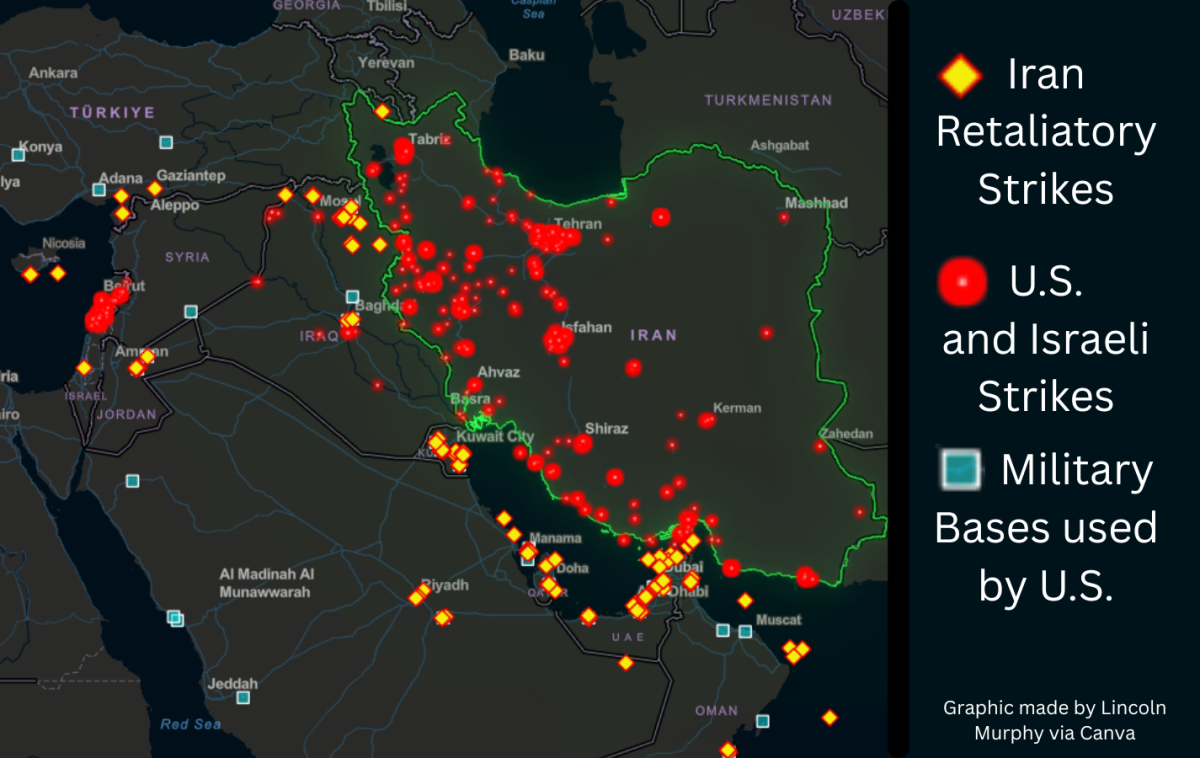
In the months leading up to March 1, the United States moved many of its military assets towards the Middle East, amid rising tensions surrounding Iran. Part of the reason was to prevent Iran from possessing a nuclear weapon. The country had also been under stress from protests against the Iranian government starting on December 28, 2025. The Iranian government retaliated by killing its own people. Some sources estimate 40,000+ people have been killed in the protests alone.
In June of 2025, the United States carried out strikes on Iranian nuclear facilities with B-2 Spirit bombers in operation “Midnight Hammer.” President Trump tried to make a deal with Iran to give up their nuclear capabilities after the bombing, but Iran refused.
As tensions rose, the United States began moving many military assets toward the Middle East throughout December, January, and February. Many warships and aircraft carriers were moved to the Middle East, including the world’s largest warship, the USS Gerald R Ford. This also included the USS Mahan, the USS Abraham Lincoln, the USS Roosevelt, and the USS Bulkeley.
Over 400+ fighter jets and aircraft have been moved over, including F-35 and F-22 Fighter jets, and KC-135 and KC-46 refueling tankers to support the movement of these planes. There were also E-3 Sentry command and surveillance aircraft, C-17A cargo aircraft, Navy P-8A patrol and reconnaissance jets, and C-5M transport aircraft, the largest in the US Air Force.
At 1:15 AM EST on March 1, more than 100 American aircraft from land and sea launched against Iranian targets, said Gen. Dan Caine, the chairman of the Joint Chiefs of Staff. This operation has been codenamed Operation Epic Fury. It was a joint strike with the Israeli Defense Forces. The first strikes hit the home of Ayatollah Ali Khamenei, the Supreme Leader of Iran, killing him and others in the strike.
In retaliation, Iran launched missiles at many countries in the Middle East, such as Israel, Jordan, the United Arab Emirates, Bahrain, Kuwait, Qatar, and many U.S. military bases in the region. The conflict has also dragged in other countries such as Azerbaijan, Sri Lanka, and Turkey. Many flights in the region were rerouted or cancelled to avoid flying in restricted airspace. The Trump administration said that the conflict could last for 3-4 weeks. As of March 25, the war is still going on. Oil prices have risen from $67 since the start of the war, to $98 on March 20, due to Iran threatening to strike any ship passing through the Strait of Hormuz, where 20% to 30% of the world’s oil passes through daily.
News is moving so fast, and things are changing in the Middle East hour by hour. Even major news outlets are having trouble keeping up with the pace of things. Some governments have started censoring citizens on social media for what they say about the war. Some social media influencers have moved to covering the war, trying to keep up with the pace that traditional news outlets cannot.